Let’s be honest—running a business can sometimes feel like juggling flaming torches while riding a unicycle on a tightrope. You’ve got leads to chase, sales to close, reports to generate, and a million tiny follow-ups that somehow never seem to end. And just when you think you’re catching up, your competitor swoops in with lightning-fast responses and a smooth automation system.
Enter Salesforce automation—the unsung hero of modern business efficiency. It’s not just another fancy software buzzword; it’s the engine that helps companies save time, increase productivity, and turn chaos into calm. If you’ve ever wondered how top-performing sales teams seem to have their act together 24/7, the answer likely lies here.
In this article, we’ll explore Salesforce automation for businesses—what it is, why it matters, and how it can completely change the way your company operates. So grab a cup of coffee (or two), because we’re diving deep into the world where technology meets smart selling.
What is Salesforce Automation (SFA)?
Salesforce Automation (SFA) is like having a digital assistant that never sleeps. It handles repetitive sales tasks such as managing leads, tracking customer interactions, scheduling follow-ups, and generating reports—automatically. No more manual data entry nightmares or forgotten client calls.
The goal of SFA is simple: to make sales teams more productive by eliminating tedious manual work. Instead of spending hours updating spreadsheets, your sales reps can focus on what truly matters—building relationships and closing deals.
Here’s how Salesforce automation typically works:
| Feature | Function | Business Benefit |
|---|---|---|
| Lead Management | Captures and tracks new leads from various sources | Faster response time and improved conversion rates |
| Opportunity Management | Monitors deal progress and next steps | Clearer visibility of the sales pipeline |
| Workflow Automation | Automates repetitive tasks like sending follow-ups | Saves time and reduces human error |
| Reporting and Analytics | Provides data-driven insights | Better decision-making and forecasting |
| Email & Communication Tracking | Logs emails, calls, and meetings | Keeps everyone on the same page |
In short, it’s your sales team’s best friend—without the coffee breaks.
Why Businesses Love Salesforce Automation
1. Time is Money (And Automation Saves Both)
One of the biggest perks of Salesforce automation is time efficiency. Think about it: every minute your sales team spends manually entering data is a minute not spent actually selling. By automating data entry, lead assignment, and email follow-ups, Salesforce lets your team focus on what they do best—building relationships.
Imagine you’re running a bakery and instead of kneading dough all day, you have a machine that does it for you while you focus on creating new recipes. That’s what automation does for sales—it frees you to innovate while the system takes care of the grunt work.
2. No More Lost Leads
Ever had a potential customer slip through the cracks because someone forgot to send a follow-up email? Yeah, we’ve all been there. Salesforce automation ensures that never happens again. With automated reminders, workflows, and lead tracking, you can make sure every prospect gets the attention they deserve—without relying on sticky notes or memory.
3. Consistency and Accuracy
Humans are great, but let’s face it—we make mistakes. Data entry errors, missed deadlines, duplicate records... it happens. Salesforce automation drastically reduces those slip-ups by standardizing processes and ensuring consistent data across your organization.
When everyone works from the same, clean data, decisions become faster, smarter, and way less stressful.
4. Better Customer Relationships
Customers today expect fast responses and personalized experiences. Salesforce automation helps businesses deliver both. With automated email sequences, personalized outreach, and timely follow-ups, you can make every customer feel like they’re your top priority—even if you’re managing hundreds of them.
In other words, Salesforce helps you scale personalization. It’s like cloning your best salesperson, without the ethical concerns.
5. Real-Time Insights That Actually Make Sense
Salesforce automation provides dashboards and analytics that show you how your business is performing—right now. You can see which campaigns work, which salespeople are crushing it, and where deals are getting stuck.
No more waiting for end-of-month reports or guessing what went wrong. You get real-time visibility, which means faster decisions and quicker problem-solving.
How Salesforce Automation Transforms Different Business Departments
Salesforce automation isn’t just for sales teams. It can revolutionize multiple departments across your organization.
| Department | How Salesforce Automation Helps | Example |
|---|---|---|
| Sales | Streamlines lead tracking, task assignment, and deal management | Auto-assign leads based on region or product interest |
| Marketing | Aligns campaigns with sales data for better targeting | Trigger follow-up campaigns after a demo request |
| Customer Service | Tracks customer issues and automates responses | Auto-create service tickets and assign to agents |
| Finance | Provides revenue forecasting and payment tracking | Generate automatic sales and invoice reports |
| HR | Simplifies onboarding and performance tracking | Automate onboarding tasks for new employees |
The beauty of Salesforce automation is that it adapts to your workflow—not the other way around.
Common Salesforce Automation Tools and Features
Let’s break down some of the coolest tools inside Salesforce that make automation possible:
1. Workflow Rules
Workflow rules are the “if this, then that” of Salesforce. For example, if a new lead comes in from your website, you can automatically assign it to a sales rep, send a welcome email, and set a follow-up task—all without lifting a finger.
2. Process Builder
Process Builder takes things up a notch by letting you create complex, multi-step automation. You can define triggers, conditions, and actions that handle everything from updating records to sending alerts.
3. Flow Builder
This is the advanced automation engine that lets you design guided workflows and even interact with external systems. Think of it as the brain behind your automation strategy.
4. Einstein AI
No, it’s not just a fancy name. Salesforce Einstein uses artificial intelligence to predict lead scoring, suggest next steps, and even forecast sales. It’s like having a data scientist in your CRM.
5. Email Automation
Salesforce integrates with email platforms so you can send automated follow-ups, reminders, and nurture sequences—without spamming or losing the personal touch.
Real-World Example: How a Business Can Benefit
Let’s say you run a medium-sized software company. Before automation, your sales team spends 30% of their time just entering data, manually sending quotes, and updating customer information. Leads often get lost, and reports take days to prepare.
After implementing Salesforce automation:
- Lead response time drops by 70%
- Sales productivity increases by 40%
- Customer satisfaction goes up because follow-ups are consistent
- Reports that took hours now generate instantly
In short, you go from chaos to control.
Challenges (And How to Overcome Them)
Of course, no system is perfect. Some businesses hesitate to adopt Salesforce automation because of challenges like setup complexity, training, or cost. But here’s the thing—these are short-term hurdles for long-term gains.
The key is to start small. Automate one process at a time—like lead assignment or email follow-ups—before expanding. Salesforce also offers tons of learning resources (and a friendly community) to help your team get up to speed quickly.
Final Thoughts: Is Salesforce Automation Worth It?
Absolutely. If you want to save time, boost productivity, and keep customers happier, Salesforce automation is a game-changer. It turns chaos into clarity and transforms average sales teams into high-performing machines.
At the end of the day, automation isn’t about replacing humans—it’s about helping them focus on the work that truly matters. So if your business still relies on manual spreadsheets and sticky notes, maybe it’s time to let Salesforce do the heavy lifting.
Because honestly, who doesn’t want more sales with less stress?
Frequently Asked Questions
1. What is Salesforce automation in simple terms?
It’s a system that automatically handles sales tasks like lead tracking, email follow-ups, and reporting—so your team can focus on closing deals instead of data entry.
2. Can small businesses use Salesforce automation?
Yes! Salesforce offers scalable solutions that fit both small startups and large enterprises. Even a small team can benefit greatly from automated workflows.
3. How hard is it to set up Salesforce automation?
It depends on how complex your needs are. Basic automations are easy to set up, while advanced ones may require help from a Salesforce admin or consultant.
4. Does Salesforce automation replace salespeople?
Not at all. It supports salespeople by handling repetitive work, allowing them to spend more time connecting with customers and closing deals.
5. What’s the main advantage of using Salesforce automation for businesses?
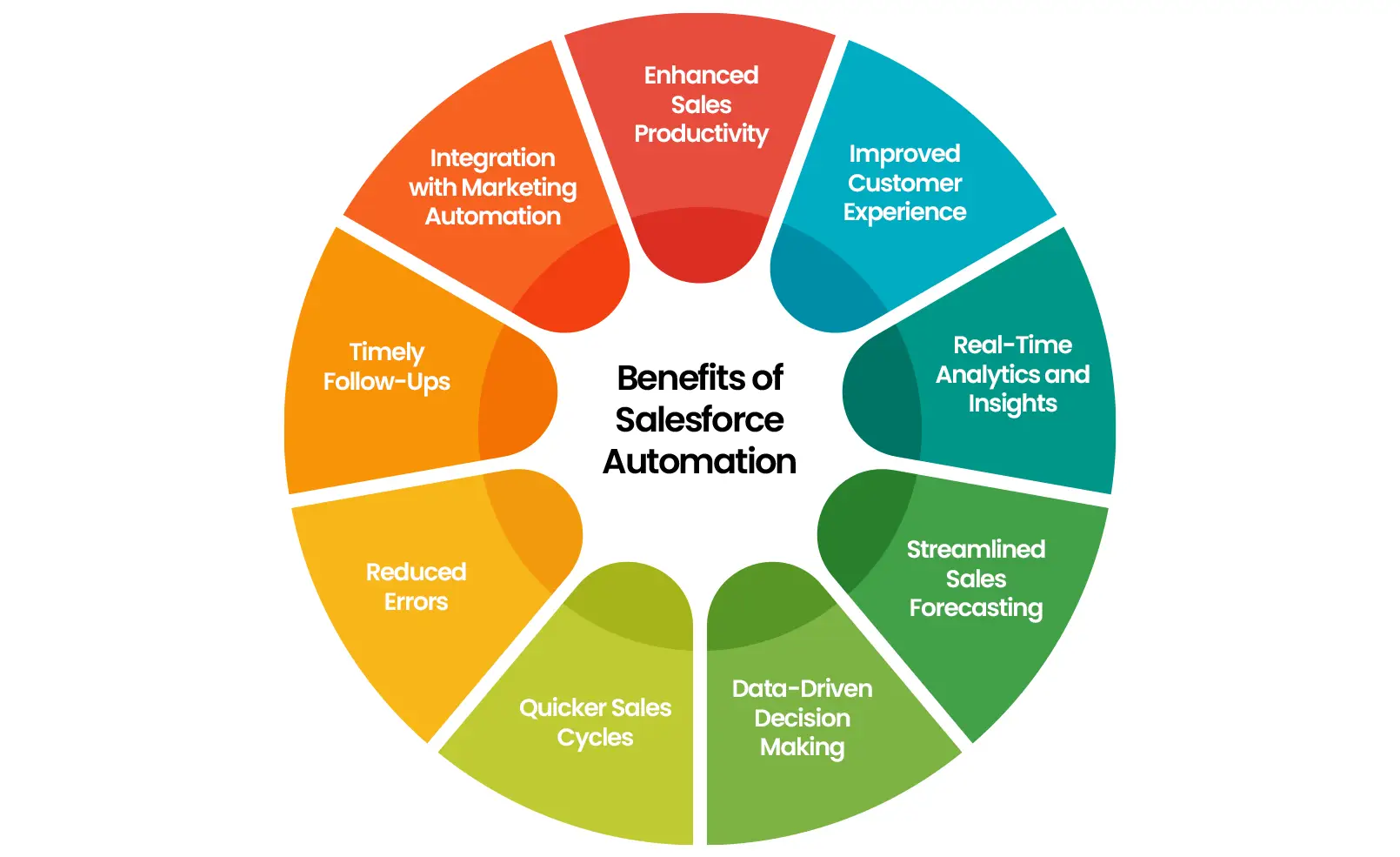
It boosts efficiency, eliminates manual errors, speeds up sales cycles, and provides data-driven insights—all of which lead to better performance and higher revenue.